
10 Cities to Experience Before and After University
By Emily Moreau.
Where someone lives in the years around university can shape the experience as much as what they study. Some people choose a city to study in, some spend a gap year somewhere new before enrolling, and many move again after graduating for a first job or a change of scene. Each stage tends to call for a different kind of place, and the cities below are grouped accordingly.
Choosing Where to Study
Choosing a university involves more than finding a degree program that matches someone’s interests. The surrounding city can also have a considerable influence on the experience, from the cost of accommodation and transportation to the cultural activities and opportunities available outside the classroom.
Online communities, social media and AI tools have become part of how students choose their university, helping them compare institutions, read first-hand accounts and narrow down their options, and the city a university sits in often becomes part of that comparison alongside course content and cost.
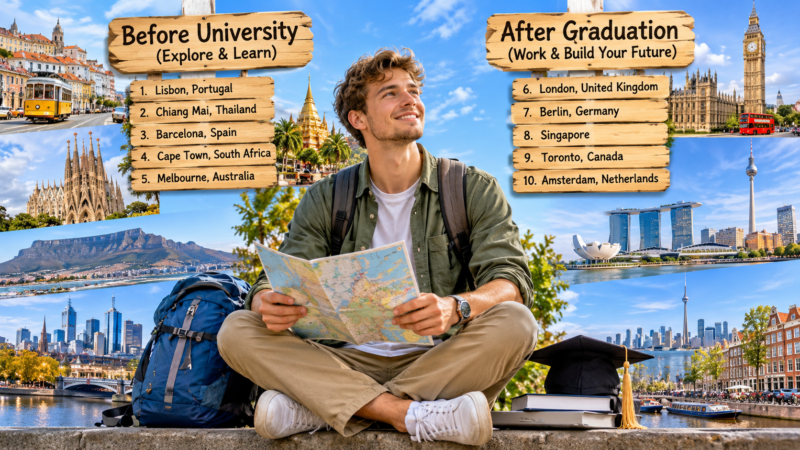
Many students also build a break into the process, taking a gap year to travel, work or volunteer before enrolling, and the same curiosity about place often returns once a degree is finished. The ten cities below are grouped by those two stages, five that suit time spent before university and five that suit graduates deciding what comes next, and several of them are also major university cities in their own right.
Five Cities to Experience Before University
1. Lisbon, Portugal
Lisbon rewards slow exploration, from the hilltop viewpoints and tiled streets of Alfama to riverside cafes and markets, with Sintra and Cascais close enough for easy day trips. Learning Portuguese is a natural way to settle in, and the large international community makes it simple to meet people from other countries, although accommodation costs have risen noticeably in recent years.
2. Chiang Mai, Thailand
In northern Thailand, Chiang Mai moves away from the country’s southern beaches toward a walled Old City, its many temples and the Doi Suthep temple on the hillside above. Night markets, cooking classes and trips into the surrounding countryside fill the days, and an established community of long-stay travelers makes it a comfortable place for solo visitors to meet people and settle into a routine.
3. Barcelona, Spain
Barcelona suits a gap year spent learning a language, since Spanish and Catalan are both part of daily life and language courses are easy to find. Between mornings in the Gothic Quarter, afternoons at Barceloneta beach and evenings in neighborhoods such as Gràcia, it is easy to build a rhythm that feels more like living there than visiting, which is much of the appeal for anyone taking time away from formal education.
4. Cape Town, South Africa
Table Mountain rises directly behind the city center, and from there beaches, hiking trails, the Cape Peninsula and the penguin colony at Boulders Beach are all within reach. For travelers interested in volunteering or a longer stay, structured programs exist, though it is worth researching the legitimacy of any organization before committing to it.
5. Melbourne, Australia
Melbourne is known for its laneway street art, independent cafes, live music venues and major sporting events such as the Australian Open, with coastal day trips offering a change of scenery. Australia also has working-holiday arrangements for eligible nationalities, which can make it possible to fund a longer stay through temporary work, so checking current eligibility and visa conditions is the first step for anyone planning ahead.
Five Cities to Experience After Graduation
6. London, United Kingdom
London’s concentration of employers in finance, technology, media, education and the creative industries gives graduates a wide range of entry points, and many of its major museums are free to enter, which helps stretch a tight budget. The main challenge is the cost of living, particularly rent, so it pays to plan carefully before relocating.
7. Berlin, Germany
Berlin appeals to graduates drawn to technology, design, entrepreneurship and the arts, with an international professional community and a history that is visible everywhere from the East Side Gallery to Museum Island. German is not essential for every role, but it makes everyday life easier and opens up a wider range of jobs.
8. Singapore
Singapore is a different proposition from Europe’s major cities, with hawker centers serving food from several cultures, efficient public transportation and an international business sector spanning finance, technology, logistics and professional services. Graduates considering a move should look into work pass requirements early, and housing is expensive.
9. Toronto, Canada
Toronto’s neighborhoods reflect communities from around the world, from Kensington Market to the waterfront, and its mix of finance, technology, healthcare and education employers sits alongside several universities and research institutions. That combination makes it a flexible base for graduates weighing a first job against further study.
10. Amsterdam, Netherlands
Amsterdam is compact enough to cross by bike, with its canals, major museums and a business community in technology, finance and the creative industries. English is widely used at work and socially, which eases the transition for international graduates, though learning Dutch helps with everyday integration and the housing market is tight.
Choosing a City at Every Stage
The habits that help when choosing a university, such as comparing options, reading first-hand accounts and checking practical details like cost and requirements, work just as well when choosing a city or even a whole country for a gap year or a first job. The priorities simply change from one stage to the next, with curiosity and flexibility counting for more before university, and work routes, housing and long-term plans counting for more afterward.

